A sample school disco message for parents
Use this once the school and parent committee have confirmed the arrangements. Make the times clear for each age group.
Our school disco takes place on [date] in [room]. For [year groups], it starts at [time] and finishes at [time]. Please use [entrance]. Collect children at [place], following [collection procedure]. Children should bring [items]. We will provide [food/drinks]. Register through [school channel] by [date]. Share any information needed for supervision directly with [school contact]. On the day, contact [name] on [number] with questions.
Include the agreed arrangements for photographs. Mention any parent contribution only after the school has confirmed the amount and payment method.
What if a helper is absent or a parent is late?
Name a backup for reception, room supervision and coordination before the day. Agree with the school who stays with a child collected late and who calls the parent. The DJ leads the programme but does not take over these school responsibilities.
Put those names beside the timetable. This lets groups change over without leaving the entrance or room unattended. The agreed DiscoShow and the school's arrangements can then work together.
Start with five clear decisions
Agree on the date, venue, participating year groups, budget and one main contact. Put these at the top of your plan so the school, parent committee and DJ all work from the same information.
This guide covers organising a primary school disco. To explore what a DJ can provide, visit our school party page.
Four to six weeks ahead: make the arrangements
Treat this as a suggested lead time. Start earlier if your school calendar fills up quickly. Confirm the date with school before inviting families or booking suppliers.
- Space: choose a hall or gym with room to move. Agree with school how many children can attend at once.
- Ages: decide which year groups will come and whether separate sessions would work better.
- Budget: include music or a show, any venue hire, drinks and decorations. Check exactly what a quote includes.
- Access: agree on setup access, who opens the doors and when the room must be clear.
- Contact: appoint one person to collect the arrangements with school and the DJ.
For an outdoor disco, agree on an indoor alternative and who decides whether to move the event.
Give each task an owner
Write a name and a time beside each task. “The committee will do it” is less useful on the day than knowing who is at the door.
- The coordinator follows the timetable and speaks to the DJ.
- The welcome team handles arrivals and collection.
- Room supervisors stay with the children and help anyone who needs a quiet moment.
- The drinks team serves refreshments away from the dance floor.
- The tidy-up team knows when the room must be handed back.
Agree staffing with school based on numbers, ages and the room layout. The DJ leads the programme. School organisers remain responsible for supervision. Arrange cover for anyone who needs to leave their position to help a child.
One disco or separate age groups?
A small mixed group may enjoy dancing together. With larger numbers and a wide age range, separate sessions allow music and games to suit each group.
Start younger children with familiar songs, short explanations and simple movements. Older children can suggest a few favourite tracks in advance. Everyone should be free to watch before joining in.
Allow time between sessions for collection, a room check and the next arrivals. Avoid sending both groups through one narrow doorway at once.
Agree the number of sessions and total performance time with the provider. Extra sessions are not automatically included in one booking.
Example timetable for the day
This example uses two 45-minute dance sessions. It is a planning suggestion, not a fixed show duration or package promise. Agree setup and performance times separately.
- Before 15:15: agreed setup, sound check and a check of clear walkways.
- 15:15–15:30: staff briefing and arrival of the younger group.
- 15:30–16:15: first dance session, with opportunities to drink or rest.
- 16:15–16:35: collection, room check and arrival of the older group.
- 16:35–17:20: second session with music and activities for older children.
- 17:20–17:35: collection and confirmation that children have left as agreed.
- Afterwards: pack-down and tidying according to the school and DJ arrangements.
Adapt the times to your school day. Breaks and changeovers belong in the plan from the start.
One week ahead: tell families what they need to know
Share the date, each group's start and finish time, entrance, collection point and contact details through the school's usual channel. Explain what children should bring.
Ask parents to discuss any support needs directly with school. Agree how photographs will be handled too. Clear information keeps questions at the door to a minimum.
Send the DJ the ages, expected numbers, room details and final timetable. Share a few favourite songs while leaving room to respond to the children on the day.
Check the room before opening
Keep exits and routes clear, secure cables and put drinks away from the dance floor. Provide somewhere to sit quietly and enough light to see people and exits.
Agree who will speak to the DJ about sound and the programme. Check that supervisors can hear one another at arrival points. Decorations are lovely, but clear space comes first.
How much does a school disco cost?
There is no single total that fits every school disco. The programme, duration, venue and tasks you handle yourselves all affect the budget. Include these items before booking:
- Music: a DJ or DiscoShow and any additional performance time.
- Equipment: lighting and sound, where these are not included.
- Venue: any room hire, cleaning and access for setup.
- Party supplies: drinks, cups and decorations.
- Other arrangements: any travel or parking charges and an allowance for unexpected expenses.
Ask for a total including VAT and check the performance time, setup and packing away. Compare quotes for the same number of sessions. Use the DiscoShow packages as a starting point and discuss your school programme before booking.
School disco checklist for your planning meeting
Assign a person and a deadline to each item. You can copy this list into the parent committee's plan.
- The date, room and participating classes are agreed with the school.
- The budget and quote details are approved.
- Performance times, setup, packing away and changeovers are confirmed.
- Arrival, supervision, drinks and tidying each have a named contact.
- Parents know the entrance, times and collection arrangements.
- The DJ knows the ages, group size and a few favourite songs.
- Walkways, the drinks area and a quiet seating spot have been checked.
- The team knows who handles the final room check and handover.
Keep the plan for next time
Afterwards, record what worked and what you would change. Save the tasks and timetable for the next parent committee.
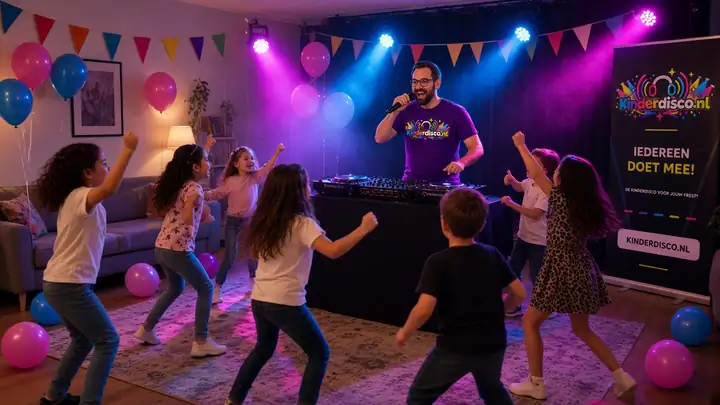
Want help with music and dance games? Kinderdisco.nl provides a DiscoShow with a DJ from the team, lighting and sound. You book the show, without a specific DJ being guaranteed in advance. Read how the DiscoShow works or share your date, venue and year groups through the request form. We can help you plan the sessions.